Driving in France: a guide for UK drivers
Once you roll off the ferry, France opens up beautifully by car – but it asks a little more of you than driving at home. There are tolls to budget for, a Crit’Air sticker to sort before you travel, and a daytime motorway limit that drops in the rain. Here is everything we have learned from doing these crossings ourselves, so you can set off prepared rather than catching it all at the roadside.
Not sure which crossing to take yet? Find your route on the homepage.
Sort your Crit’Air sticker before you travel
This is the one thing to do well before you set off. France’s low-emission zones (zones a faibles emissions, or ZFE) now cover every city of more than 150,000 people, and to drive into one you need a Crit’Air sticker displayed on your windscreen.
- Buy it only from the official French government site (certificat-air.gouv.fr). It costs around €10, and copycat sites charge far more for the same thing.
- It can take a couple of weeks to arrive by post, so order it as soon as your trip is booked, not the week before.
- The sticker is colour-coded by how clean your car is, from Crit’Air 1 (cleanest) to 5. Most modern petrol and diesel cars qualify for a usable category.
- Driving in a zone without a valid sticker risks an on-the-spot fine of €68.
If your route only uses motorways and city ring roads, you can often skip the zones entirely. But if Paris, Lyon, Bordeaux or any big city is on your itinerary, get the sticker – it is cheap insurance against a fine and a spoilt day.
Getting used to driving on the right
In France you drive on the right, with the steering wheel on the “wrong” side if your car is from the UK. Most people adjust within an hour, but the first stretch off the ferry is when mistakes happen. From our own trips, here is what helps:
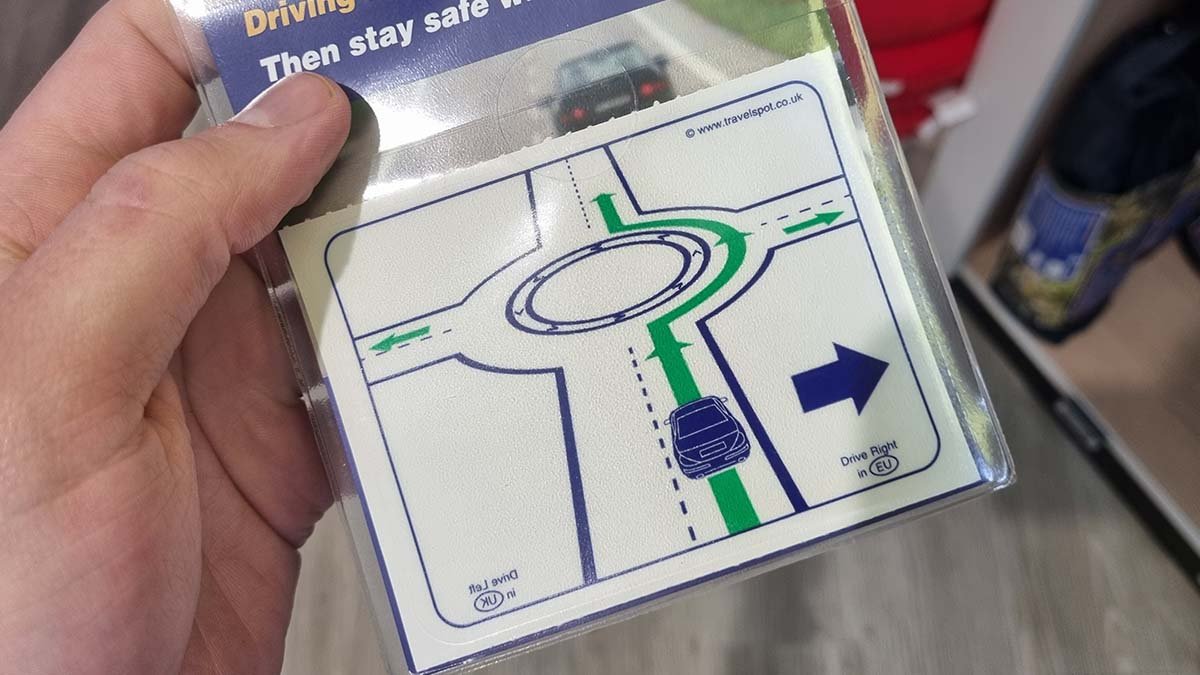
- Keep repeating “stay right” to yourself in the first hour – it really does build the habit. You can also buy window reminder stickers in the ferry shops.
- Where you can, follow a local car. Driving behind someone who knows the roads is far easier than working out every junction yourself.
- If you have a passenger, ask them to actively watch and call out, especially at junctions and roundabouts.
- At roundabouts, traffic goes anti-clockwise – the opposite of the UK. Look left as you approach, and give way to traffic already on the roundabout.
- Preview the first junctions on Google Street View before you travel, so the layout off the ferry feels familiar.
- Stay calm and don’t let yourself be rushed. Most slip-ups happen when people panic.
Driving a hire car? Then the wheel is on the left and you’ll change gear with your right hand – an automatic can make life easier. The indicators and wipers are often reversed too, so don’t be surprised if you set off with the wipers going.
Speed limits: and they drop in the rain
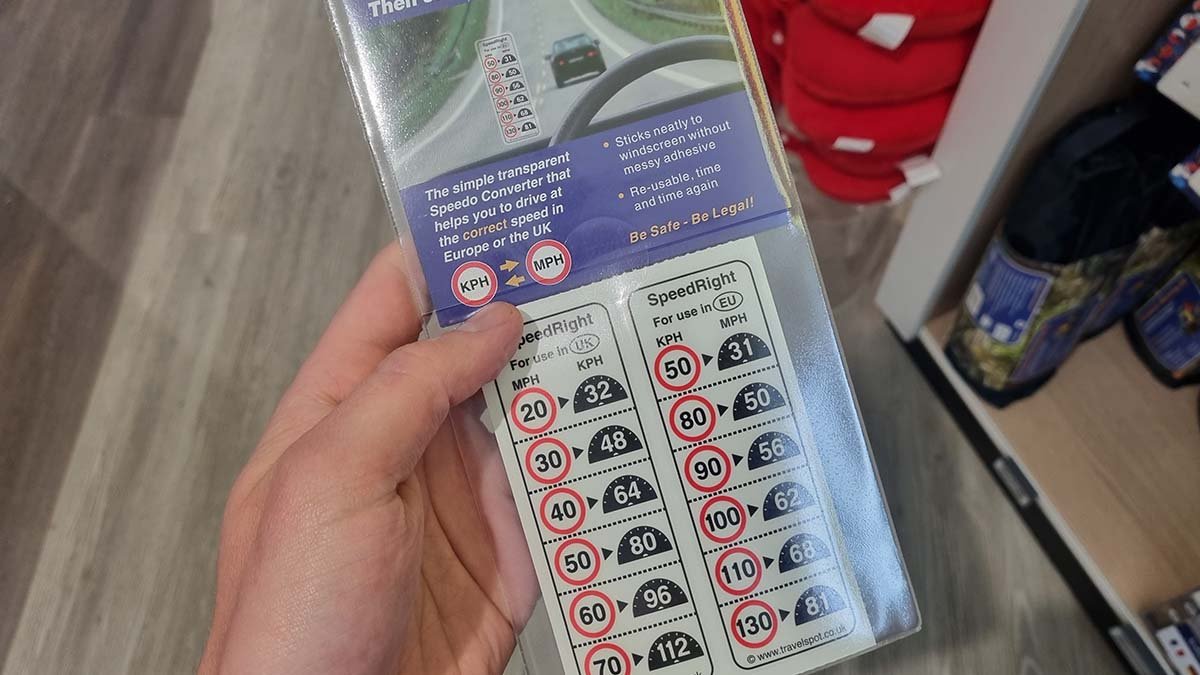
Speeds are in kilometres per hour, not miles. One mile is about 1.6 km, so 50 mph is roughly 80 km/h. Many drivers buy a small conversion sticker (sold on the ferry) for the dashboard.
The catch UK drivers miss is that French limits drop when it rains. On the autoroutes the limit is 130 km/h in the dry but 110 km/h in the wet; on dual carriageways it falls from 110 to 100. The wet limit is real and enforced by cameras that can adjust for conditions, so ease off as soon as it starts to rain.
As a rough guide otherwise: rural roads are 80 km/h (some restored to 90), built-up areas 50 km/h, and town centres often 30. A town’s name on a sign marks the start of the 50 limit; the same name crossed out marks the end. Drivers with under three years’ experience must keep to the lower rain limits at all times.
Tolls: budget for the peage
Unlike at home, most French motorways are tolled, and on a long trip it adds up. France runs the largest toll network in Western Europe, charging by the kilometre at around €0.11 for a car.
- Motorways are marked with an A (autoroute) and almost all are tolled; you pay at barriers (peage) by card or coins.
- Costs are real: Paris to Lyon is roughly €41, Paris to the south coast around €85-95. Use a toll calculator to budget your route.
- An electronic tag (Ulys, Liber-t or Emovis) lets you glide through the télépéage lanes without stopping, with the fee taken automatically – worth it for longer or repeat trips.
- Free alternatives run on the N (national) and D (departmental) roads, and some routes like the A75 through the Massif Central are toll-free. They are slower but often more scenic.
Watch the lane signs at the barriers: an orange “t” means tag-only (télépéage), and some lanes are card-only with no coin basket. If you end up in the wrong one, there is a button to call an attendant.
What you must carry in the car
France asks for more kit than the UK, and the police can fine you on the spot for missing items. A ready-made France driving kit covers most of it in one go.
- Warning triangle – to place behind the car if you break down.
- Reflective hi-vis vest – kept inside the cabin, so you can put it on before getting out, not in the boot.
- Headlamp beam deflectors – so your lights don’t dazzle oncoming traffic, or adjust the beam via your car’s controls.
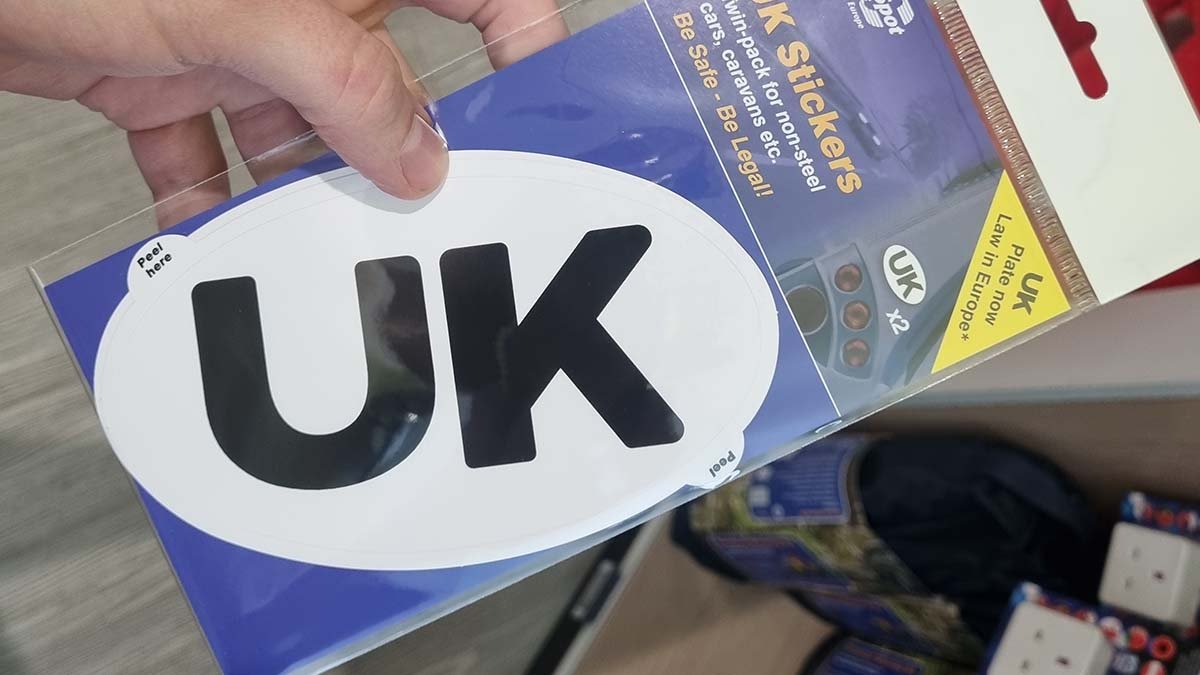
- UK sticker – unless your plate already shows “UK” with the flag. (The old “GB” is no longer valid.)
- Spare pair of glasses – if you need them to drive, a spare set is required by law.
- Documents – full UK photocard licence, V5 logbook, insurance certificate and passport.
- Crit’Air sticker – required for the low-emission zones; see above.
- First-aid kit – not required, but always sensible.
- Snow chains or winter tyres – required in designated mountain “snow zones” between 1 November and 31 March (the Alps, Pyrenees, Massif Central).
- European breakdown cover – and a note that a breathalyser is no longer required by law.
Low-emission zones: where they apply
The Crit’Air sticker is what gets you into France’s low-emission zones (ZFE). As of 2026 these cover all cities of more than 150,000 people, and the list keeps growing.
- Major zones include Paris, Lyon, Marseille, Bordeaux, Lille, Strasbourg, Toulouse and Montpellier, among others.
- Restrictions are by Crit’Air category and can tighten during high-pollution episodes, when the dirtiest categories are temporarily banned.
- Enforcement is by camera against your vehicle’s emissions class, and the sticker must be displayed even if your car qualifies.
- If you are only passing a city on the motorway or ring road, you usually stay outside the zone – but carry the sticker if there is any chance you’ll drive in.
Many visitors heading into a big city simply use a Park & Ride on the edge and take the tram or metro in, side-stepping the zone and the city traffic in one go.
The drink-drive limit is lower than the UK
The French drink-drive limit is 0.05% (0.5g of alcohol per litre of blood), lower than the 0.08% in England, Wales and Northern Ireland, though the same as Scotland. For drivers with under three years’ experience it is stricter still, at 0.02%.
Police test regularly, and fines for foreign drivers are enforced. The safest approach, as ever, is simply not to drink at all before driving.
Don’t forget your headlights
UK cars are set up for driving on the left, so your headlights are angled to light the left verge – which dazzles oncoming traffic once you’re driving on the right. Fit headlamp beam deflectors (cheap stickers, sold in the ferry shop) before you set off, or adjust the beam manually if your car allows it. Some newer cars have a simple setting for “driving on the right”.